
Van Buren County Projected vs Actual Release
A projected date is a calculation or eligibility marker based on the information known at that time. Actual release is the event when the holding agency completes its process and custody ends or moves. The two dates can differ for lawful reasons. A court may enter a bond or time-served order, yet another hold can keep the person in custody. A Parole Board may gain jurisdiction on an eligibility date without granting parole.
Van Buren County has two central paths. The county jail path relies on the judgment, jail time computation, court-awarded credit, holds, and the Sheriff’s actual release record. The state path uses Michigan’s indeterminate sentence and OTIS fields. One cannot be used as a substitute for the other.
Scheduled versus actual: An eligibility or calculated date is not proof of physical release; confirm the final event with the agency that held the person.
A pretrial detainee generally has no set release date. Bond may allow conditional exit, but it must be satisfied and staff must clear other warrants or holds. A county jail sentence can be computed, but Van Buren County publishes no online release-date calculator. A state prisoner’s public fields describe MDOC sentence milestones, not a county jail schedule.
Find Van Buren County Projected Date
Begin with the agency that has custody. The Van Buren County released-inmate search path can help identify the custody system when the current location is not clear. Once the system is known, keep county jail, state prison, and court records in their proper roles.
- Check the official Van Buren current-inmate list only to see whether the person remains listed. The roster does not publish a projected exit field.
- For a pretrial or county-sentenced person, review the 7th District or 36th Circuit record for bond, judgment, sentence, and time-served entries.
- Call Van Buren County Corrections at 269-657-2171 and ask what existing computation or release record can answer the date question.
- For a Michigan state prisoner, open OTIS and search by six-digit MDOC number or last name. Set status to
ALLif parole or discharge is possible. - Open the full OTIS record and read Earliest Release Date, Maximum Discharge Date, Date Paroled, status, location, and sentencing information together.
- Confirm an actual county release with the Sheriff release form, or an MDOC discharge with the appropriate state record or certificate.
OTIS excludes county-jail-only people and city lockup prisoners. A Van Buren County felony charge alone does not create an OTIS record. MDOC must have custody or supervision involvement. Conversely, a person transferred from the county jail to MDOC may drop from the local roster before the state location appears.
Van Buren County MDOC Release Fields
The live OTIS search has name and MDOC-number fields plus a status selector. Use the unique MDOC number when possible. The system is spelling-sensitive, and official instructions permit a wildcard after three leading surname letters.
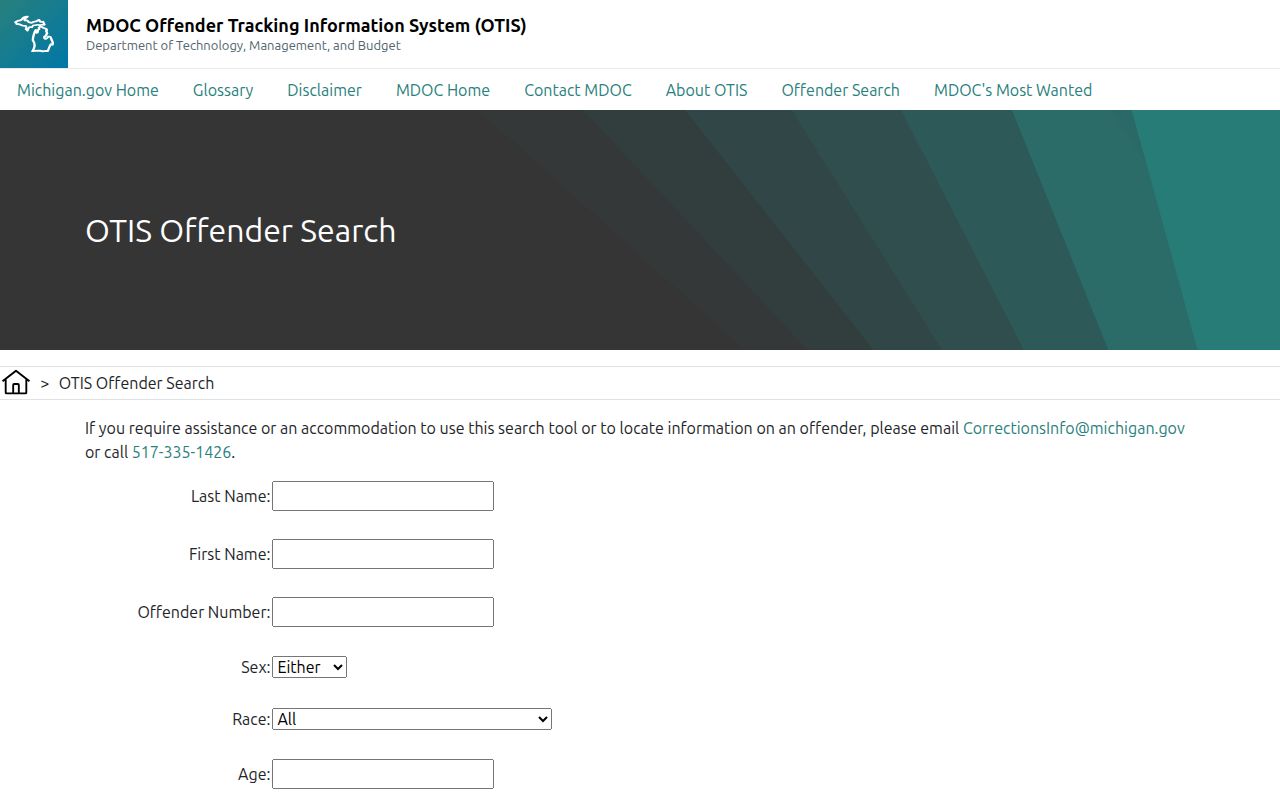
The search screen is only the entry point. The detailed offender record contains the sentence dates and status needed to distinguish eligibility, parole, and discharge.
| OTIS field | How to read it |
|---|---|
| Earliest Release Date | The point when Parole Board jurisdiction can begin after the minimum and applicable legacy credits; not a release appointment. |
| Maximum Discharge Date | The calculated outside date for the controlling sentence, subject to credits and other lawful custody. |
| Date Paroled | An actual date when parole status began after prison or another nonsecure setting. |
PAROLE | Community supervision under continuing MDOC legal custody, not final discharge. |
DISCHRG | MDOC supervision ended for the displayed sentence; read the whole record for the route and context. |
| Location | The prison or field office tied to current custody or supervision. |
OTIS shows discharged people for three years after supervision discharge. A later blank result may be expected. Older proof can require the sentencing court, MDOC records, or a formal discharge document.
Note: Date Paroled is an actual transition into parole, while Earliest Release Date only marks possible Board jurisdiction.
Michigan Minimum-Sentence Release Rule
Michigan must not be described with a generic “85% rule.” For covered truth-in-sentencing offenses, the person serves 100% of the judicial minimum before parole consideration. The state identifies specified assaultive offenses committed on or after December 15, 1998 and other covered offenses committed on or after December 15, 2000 within this framework. The minimum is the court-set minimum term, not a casual estimate from the maximum.
The official Michigan truth-in-sentencing explanation states the service-of-minimum rule for covered sentences.
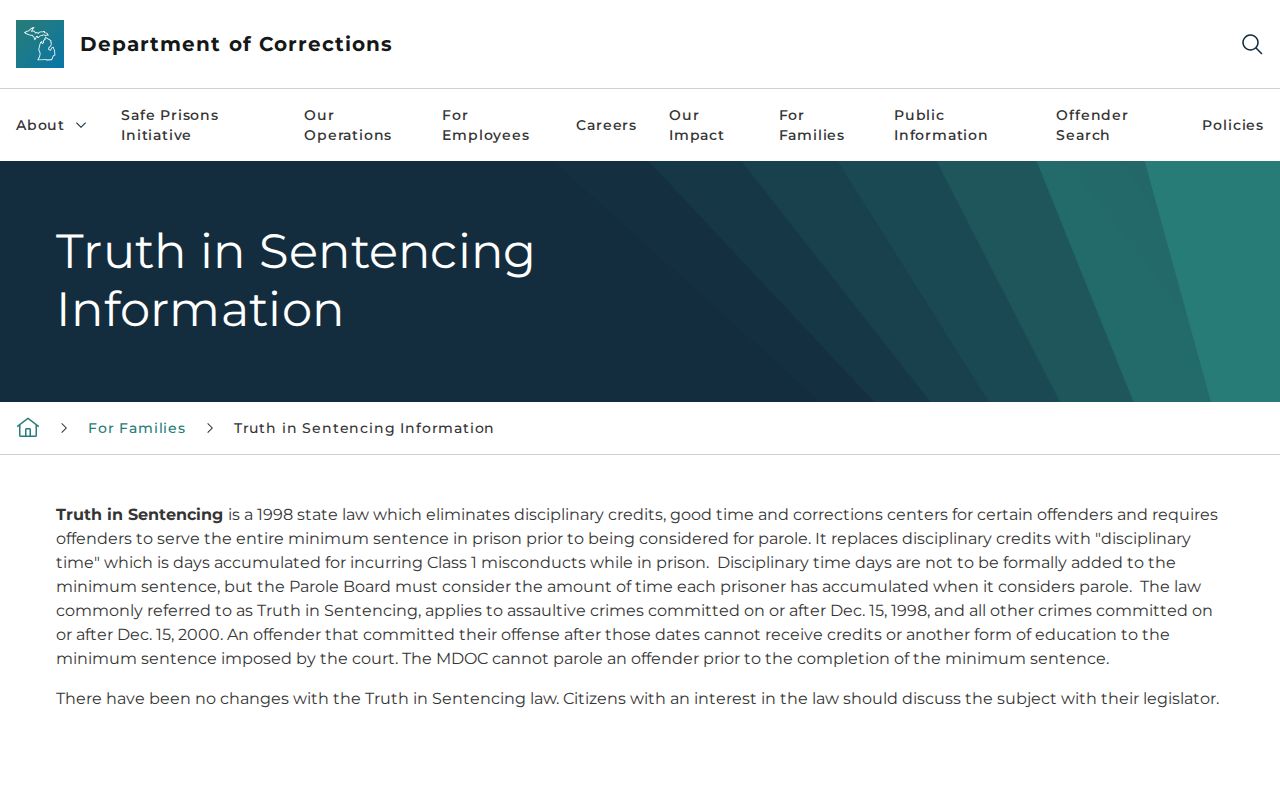
The state explanation supports a 100%-of-minimum statement for covered cases and rejects an unsupported universal percentage shortcut.
Truth in sentencing eliminated good-time or disciplinary-credit reduction of the minimum for covered sentences. Misconduct can still affect the Parole Board’s later decision. Reaching the minimum means eligibility for consideration, not a right to leave that day. The Board may grant, deny, defer, suspend, or rescind action within its authority.
Legacy prisoners may have good-time or disciplinary-credit treatment under MCL Chapter 800 and related provisions, depending on the offense date and type. MCL 791.234 governs parole jurisdiction and special sentence categories. No single days-per-month formula works across all Michigan cases.
Van Buren County Jail Release Computation
No official Van Buren County projected-release calculator was found. A jail-only date depends on the court judgment, jail computation, credit ordered by the court, other holds, and operational processing. A person awaiting trial has no sentence-based date to calculate. Bond or a later court order can create a path to release, but neither establishes when physical processing will finish.
For a sentenced local inmate, review the judgment and any time-served language. Then ask the jail for the existing computation or release record. Michigan FOIA permits a request for an existing record, but it does not require the Sheriff to create a new calculation or answer an open-ended question. The actual release form is stronger evidence than an estimate.
A court order and jail event should be paired. All Van Buren adult criminal matters begin in 7th District Court, while felony adjudication and sentencing proceed in 36th Circuit Court. A district preliminary event may not be the final felony sentence. Another warrant or receiving agency can also turn a local departure into transfer rather than community release.
Note: Van Buren County publishes no guaranteed release-processing time, so do not infer an exit hour from the judgment date.
Why Van Buren County Release Dates Change
A release date can move because the legal authority, sentence calculation, or destination changes. The same factor can have a different effect in county and state custody. For example, a Parole Board decision affects an MDOC prison sentence, while a local bond order affects the county-jail case.
| Factor | Possible effect | Best confirmation source |
|---|---|---|
| Parole grant, denial, or deferral | Changes whether prison release follows eligibility and when planning proceeds | OTIS, Board notice, MDOC |
| Misconduct or adverse information | Can affect Board action or cause a grant to be suspended or rescinded | MDOC and Board record |
| Sentence or court correction | Changes the legal minimum, maximum, credit, or local jail term | Sentencing court and corrected computation |
| Legacy good-time credit | May change dates only when the offense and sentence qualify | MDOC time-computation record |
| Warrant or detainer | May keep the person held or send them to another agency after one custody ends | Holding agency and receiving agency |
| Other sentence or jurisdiction | Can make “released by one agency” a transfer into another custody system | Release record, destination field, other locator |
MDOC policy requires checks for detainers, warrants, protection-order information, and LEIN data near discharge. The person can complete the displayed MDOC sentence and still be delivered to another authority. Therefore, “left MDOC” and “returned home” are not the same statement.
A parole grant also needs time for release planning. MDOC describes the grant moving to its release unit and assigned field agent before physical exit, and a grant can be challenged, suspended, or rescinded in the circumstances the agency identifies. The eligibility date, Board decision date, and Date Paroled may therefore be three separate milestones.
Van Buren County Weekend MDOC Discharge
Michigan’s weekend rule is unusually specific. Under MDOC Policy Directive 03.01.135, a maximum discharge that falls on a weekend or state holiday occurs on that exact date. MDOC does not move the maximum discharge to Friday merely for convenience. This rule applies to an MDOC maximum discharge and should not be copied onto ordinary Van Buren County Jail bond or court releases.
The same policy defines the state discharge date as the controlling maximum less applicable credits or the parole discharge date set by the Board. MDOC generates a sentence-discharge report around 180 days before maximum, reconciles database information no later than 30 days before, and verifies calculations around 120 days. These are internal preparation steps, not three separate release promises.
An ICE request may seek up to 48 additional hours, excluding weekends and federal holidays, after the discharge point. Another jurisdiction may also take custody. The final certificate and destination determine whether the person returned to the community or moved to a new authority.
That added hold period is not extra punishment on the completed Michigan sentence. It is a limited request tied to possible immigration custody. The receiving agency’s record must be checked separately because the MDOC maximum date answers only the state-sentence question.
Weekend distinction: MDOC keeps an exact weekend maximum-discharge date, but no source establishes the same scheduling rule for Van Buren County Jail releases.
Confirm Van Buren County Actual Release
A county release should be confirmed with the Sheriff’s actual release form and relevant court record. Ask for the timestamp, disposition, and destination or receiving agency when available. A roster disappearance alone is not proof because the person may have transferred to MDOC, another county, federal custody, or immigration custody.
For MDOC, read OTIS and request formal proof when needed. Policy identifies the CSJ-130 discharge or sentence-termination certificate and, for successful parole completion, the CAX-115 Parole Board discharge order. A Date Paroled confirms the transition to community supervision, while a later discharge record confirms the end of the displayed supervision.
Michigan VINE can add timely notice of a pending custody change. Register on the correct person record and read whether the alert says release or transfer. The Van Buren County VINELink check explains phone, text, email, and PIN confirmation. Pair the alert with the originating record when the exact release type matters.
Release dates should always be tied to an agency and a legal event. An Earliest Release Date answers when Board jurisdiction can begin. A Maximum Discharge Date answers the calculated outside sentence date. A jail release form or Date Paroled records what actually occurred.